High School Students
These high school students did projects in our lab
and entered the Intel/Westinghouse
Science Talent Search (semifinalists are starred
)
and other national competitions (prizes are starred
).
2015 |2014 |2013 |2012 |2011 |2010 |2007 | 2006 | 2005 | 2004 | 2003 | 2002 | 2001 | 2000 | 1999 | 1998 | 1997
| |
|
Puja Sengupta (2014-2016). The effect of age on pleasure. JSHS (Junior Science and Humanities Symposium): Semi-finalist. Hicksville High School, 2017. |
 |
|
Anett Cherkassky (2015-2016). The Halo Effect; determining how physical appearance and characteristic traits impact the attractiveness of a person, Poly Prep Country Day School, 2017. |
 |
|
Brett Restrick (2015-2016). Changing the Characteristics Associated with the Color Blue in Marketing Initiatives. NYCSEF: promoted from the preliminary round to the Final round which will be on March 29th. Poly Prep Country Day School, 2017. |
 |
|
Quetourah Dalencourt (2015-2016). How Does Peer Pressure Affect One's Perception of Beauty? TEPTU: Finalist. NYCSEF: Preliminary Round. JSHS (Junior Science and Humanities Symposium): Semi-finalist. Midwood High School at Brooklyn College, 2016. |
| |
|
Alexander Pan (2014-2015). The size and spacing limits of word recognition. 2nd place in the Human Behavior/Social Science division of the Sigma Xi Research Showcase Competition. Bronx High School of Science, 2016. |
 |
|
Noopur Ranganathan (2013-2015). Effect of Text Direction on Reading Speed. First Place (Senior Division)- Behavioral Science Category, Dr. Nelson Ying Orange County Science Exposition-2014, Cash award of $100. Analysis of Peripheral Vision to Aid the Reading Process in Patients with Macular Degeneration. First Place (Senior Division)- Behavioral Science Category, Dr. Nelson Ying Orange County Science Exposition-2015, Cash award of $100; Outstanding Researcher Participant Award, Donald Cram Scholarship from Rollins College, Winter Park, $20,000 Florida Scholarship Award; Grand Prize "Ying Scholar" Award at the Dr. Nelson Ying Orange County Science Exposition-2015, Expense-paid trip to compete in Florida State Science and Engineering Fair in Lakeland, FL (March/April 2015), Expense-paid trip to compete in the Intel ISEF in Pittsburgh, PA (May 10-15, 2015) Scholarship Award of $1000. Third place award at the Florida State Science and Engineering Fair in Lakeland, FL. Finalist: placed second in the Behavioral Sciences category at the Intel ISEF 2015 on May 15th in Pittsburg. Trinity Preparatory School (Winter Park, FL), 2017. |
|
|
Ava Dishian (2014). Is looking longer more pleasurable? Hastings High School, 2015. Submitted to 2015 Intel Science Talent Search. Oberlin College, 2019. |
|
|
Campbell Silverstein (2014). How do speed-reading apps affect comprehension? Hastings High School, 2015. Submitted to 2015 Intel Science Talent Search. |
|
|
David Glaser (2014). Does sound help or hinder creativity? John F. Kennedy High School, 2015. Submitted to 2015 Intel Science Talent Search. |
|
|
Emma Rodney (2012-2014). Slow learning of unfamiliar letters predicts slow reading of English: Early screening test for dyslexia? Poly Prep Country Day School, 2015. Submitted to 2015 Intel Science Talent Search. Accepted by Penn and Cornell and wait listed at Duke and Harvard class of 2019. |
|
|
Michelle Qiu (2014). The number of V1 neurons required to see letters. Fayetteville High School, Fayetteville, Arakansas, 2015. Submitted to 2015 Intel Science Talent Search. Columbia University, 2019. |
|
|
Sonia Persaud (2014). Emotions impair recognition. Saint Francis Preparatory School, 2015. Submitted to 2015 Intel Science Talent Search. |
 |
|
Kristen Dudek (2012-2014). What text property determines reading acuity? Pelham Memorial High School, 2014. |
 |
|
Kyle Blidy (2011-2012). The effects of word isolators and text size on reading speeds in patients with age-related macular degeneration. Francis Lewis High School, 2013. Submitted to the New York City Science and Engineering Fair (NYCEF) in Fall 2012. |
 |
|
Zofii Kaczmarek (2012-2013). Why do word breaks speed reading? Stuyvessant High School, 2013. Submitted to 2013 Intel Science
Talent Search. |
 |
|
Elska Kaczmarek (2012-2013). One universal critical spacing of crowding on the brain. Stuyvessant High School, 2013. Submitted to 2013 Intel Science
Talent Search. |
 |
|
Carolyn Yao (2012-2013). The number of features used to identify a word depends on the number of possible words. Stuyvessant High School, 2013. Submitted to 2013 Intel Science
Talent Search. |
 |
|
Krisha Mehta (2011-2013). The number of cortical neurons used to see. Bronx Science High School, 2013. Submitted to 2013 Intel Science
Talent Search. |
| |
|
Mena Youssef (2011) “Dyslexia
is predicted by very slow learning of letter names.” Bard High
School Early College, Queens 2012. Submitted to 2012 Intel Science Talent
Search. Going to Princeton University in 2012. |
| |
|
Gabrielle Frenkel (2011) “Summation
of audio-visual stimuli by children: Does it help or hinder perception?”.
The Bronx High School of Science 2012. Submitted to 2012 Intel Science
Talent Search. |
| |
|
Anca Dogaroiu (2010) “Development
of visual span”. Stuyvesant High School, 2011. Submitted to
Intel Science Talent Search.New York City Science and Engineering
Fair (NYCSEF): Third award in behavioral sciences and Air
Force award for an outstanding science or engineering fair project. Four-year scholarship by Milton Fisher Scholarhip for Innovation and Creativity. |
| |
|
Laura Werle (2010) “Limited
reading: Locating the ceiling of reading speed and comprehension”. Schreiber
High School, 2011. Submitted to Intel Science Talent Search. |
 |
|
Sushi Subburamu (2007 - 2010) Does
ugliness affect judgment? The effect of typography on movie choice.
Bronx
High School of Science 2010. |
 |
|
Elizabeth
Kierstead (2006) Seeing the noise. Does visual
noise affect visual sensitivity? Stuyvesant
High School, 2007.
Finalist
in the New
York City Science and Engineering Fair (NYCSEF). Now undergraduate at
Columbia University 2011. |
 |
|
Marian Zhen (2006) Is visual
memory verbal? Midwood
High School, 2007. Mentors: Denis Pelli and Katharine Tillman.
Finalist
in the New
York City Science and Engineering Fair (NYCSEF). Semi-finalist
in the Junior
Science and Humanities Symposium (JSHS). Studied Chinese and Chinese Contemporary Culture at Peiking University summer 2008. Now undergraduate majoring in Chemistry (with a possible double major in Economics) at
NYU 2011. |
 |
|
Jake Baron (2005–2006) The limits of counting. Stuyvesant
High School, 2006. Presented poster at
2006 Visual Sciences Society meeting. A.B. Mathematics at Dartmouth
College 2009. M.Sc Applicable Mathematics at London School of Economics, 2010. Now graduate student in Math, working on combinatorics, at Rutgers University. |
| |
|
Cayla Bergman (2005) Reading
development: Letter by letter decoding in English and Italian readers. Plainview
Old Bethpage John F. Kennedy High School, 2006. Mentors: Marialuisa
Martelli and Denis Pelli. Semi-finalist
in the Junior
Science and Humanities Symposium (JSHS). Presented poster at
2006 Visual Sciences Society meeting. Now undergraduate at Vanderbilt
2010. |
| |
|
Elaine Cheng (2004–2005) East
meets West: A western attempt to explain recognition of Chinese
characters. Bronx
High School of Science 2006. Mentors: Denis Pelli and Katharine
Tillman. Now majoring in history and environmental science at NYU
2010. |
 |
|
Yi
Cui (2005) Skimming. Bronx
High School of Science 2006. Mentors: Denis Pelli and Katharine Tillman.
Over summer of 2008,
he's "in
LA working part time for a fashion wholesaler, working on Netsuite,
an ecommerce software for small businesses." Now majoring in
math at Duke University 2010. |
 |
|
Iman Hassan (2005) A focus on
reading.
Stuyvesant High School, 2006. Mentors: Denis Pelli and Jordan Suchow.
Now undergraduate at Columbia 2010. |
| |
|
Jason Rosenblatt (2005) The use
of prior knowledge in reading. Plainview
Old Bethpage John F. Kennedy High School, 2006. Mentors: Denis Pelli
and Katharine Tillman. Semi-finalist
in the Junior
Science and Humanities Symposium (JSHS). Now majoring in Economics
at University of Michigan 2010. |
 |
|
Jordan
W. Suchow (2003–ongoing) Learning to identify letters:
Generalization in high-level perceptual learning. Irvington
High School, 2005. Presented poster at
2005 Visual Sciences Society meeting. Suchow & Pelli (2008).
Letter learning: Feature detection and integration [Abstract]. Journal
of Vision. Suchow & Pelli (submitted) Learning to Detect and Combine the Features of an Object. BA in Neuroscience at Brandeis University 2009. Now graduate student in Psychology at Harvard University with George Alvarez. |
 |
|
Intel 2004 semifinalists at NYU. In the
last row, from the right, you see Henny Admoni and Lyuba Azbel (wearing
a blue scarf). Betty Kolod (not shown) was out of town. |
Henny
Admoni (2003–2004) Counting features: Quantifying discrete parts
in visual object identification.
Great
Neck North High School, 2004.
Intel
International Science and Engineering Fair (ISEF) in Portland, Oregon: $20,000
portable undergraduate scholarship from Dept. of Homeland Security,
$5,000
Best of Category Award for Top First Place Winner from Intel,
$3,000
First Award from Intel,
$3,000
First Award from U.S. Air Force,
$1,000
First Award from American Psychological Association, and
Seaborg
SIYSS Award - expense-paid trip to attend Nobel ceremony in Stockholm.
Long
Island Science and Engineering Fair (LISEF): Best in Category - Behavior
Sciences. BA in Computational Cognitive Science at Wesleyan University
2007. Now studying for MA in Computer Science at Wesleyan 2008. Planning
to pursue "a PhD in Computer Science, with a heavy focus on Artificial
Intelligence and Cognitive Science."
Lyuba
Azbel (2003–2004) How do the deaf read? The paradox of performing
a phonemic task without sound.
Midwood
High School, 2004.
The
U.S. Army, Navy, and Air Force sponsored 42nd National
Junior Science & Humanities Symposium (JSHS) contest in Baltimore,
Maryland: Third Place Winner - $2,000 scholarship.
New
York Junior Science and Humanities Symposium: Second Place Writing Award.
BA in Russian and Eastern European Studies at Wesleyan University 2008.
Elizabeth “Betty” Kolod
(2003–2004) How does learning sign language affect visual perception?
Midwood
High School, 2004.
Intel
International Science and Engineering Fair in Portland, Oregon: $1,500
Second Award from Intel. BA in Chemistry from Wesleyan University
2008. Working "in dr.
rex pratt's bio-organic chemistry lab, synthesizing and evaluating
inhibitors of of beta-lactamases, the enzymes responsible for bacterial
resistance to antibiotics." Now continuing
this research towards MA Wesleyan 2010.
Hang Xu (2003–2004) The time course of beauty. Stuyvesant
High School, 2004.
Undergrad
at Rhode Island School of Design.
Samba
Silla (2002–2003) Gestalt rules the corner of your eye.
Poster
at VSS
.
Stuyvesant High School, 2003. BA in Psychological and Brain Sciences at
Dartmouth College 2007. Taught English
at a college in Si-Ping, a small city in north-eastern China. Now paralegal at
Curtis, Mallet-Prevost, Colt & Mosle LLP.
 |
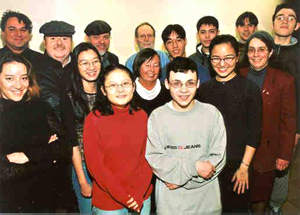
Intel 2002 semifinalists at NYU. Moon Hee
Lee is in front row, wearing a red sweater. Amber Liang is immediately
behind her. They were mentored by Denis Pelli (back row, far left) and
Marialuisa Martelli (first row, far left). |
Moon
Hee Lee (2001–2002) Combining orientations to identify letters.
Poster
at VSS
.
Stuyvesant High School, 2002. Now undergrad in Bio-Neuroscience and Human
Development at University of Chicago 2006. “I
am in a lab studying cerebellum development. We identified a couple of
genes that might be linked to autism in humans. And I am studying culture
and mental health with a professor in human development.”
Amber Yan
Xian Liang (2001–2002) Readers beware! Effects of visual noise
on the channel for reading.
Poster
at VSS
.
Stuyvesant High School, 2002. BA in Psychology at Cornell University
2006. "After graduating, I went to Japan
as part of the JET Program, which is sponsored by the Japanese
Ministry of Education to improve English education in Japanese public
schools. I spent an amazing two years in a small rural city teaching
English in a Japanese High School and I've just returned to New York.
It's pretty difficult in the current economic environment, but I'm trying
to find a job in the corporate world."
Kristen Lam (2000–2001) Does language determine
thought? Visual communication parallels verbal language.
Stuyvesant
High School, 2001. BA in Finance and International Business at Georgetown
University 2005. Now studying Law at Georgetown 2008.
Lisa Qiong Wu (2000–2001) Are
faces special? A visual object recognition study: Faces vs. letters.
Stuyvesant
High School, 2001.
Jeremy Fox (2000–2001) Identifying emotions
in faces: A developmental study.
Poster
at ECVP
.
Stuyvesant High School, 2001. BA in Psychological and Brain Sciences
from Johns Hopkins University 2005. Currently
a doctoral candidate in clinical psychology at the University at Albany,
SUNY 2010. "My research interests focus primarily on the developmental
psychopathology of anxiety and mood disorders. And my ultimate goal is
to develop a program of research that facilitates the development of
early screening and prevention programs for children at risk for anxiety
and depression."
Nila
Leigh (1999–2000) Who needs cheeks? Eyes and mouths are enough
for emotion identification & Evidence for a face superiority effect.
Stuyvesant
High School, 2000. BA in Drama at NYU 2004.
Eunice Jo (1999–2000) Crowding affects reading
in peripheral vision.
Stuyvesant
High School, 2000.
Edward Kim (1998–1999) What makes a letter?
Stuyvesant
High School, 1999. BA in Comparative Politics at Dartmouth 2003. Analyst
at CQ Partners, 2003-2006. Now Equity Research Associate, Life Insurance
Sector, UBS.
J. Y. Kim (1998–1999) Identifying expressions
of upside-down faces.
Corrina Moucheraud (1997–1998) Recognizing the
expressions of a letter. Stuyvesant High School, 1998. BA in French,
with minor in Biology, Wellesley University 2002. Now graduate student in
Health Behavior and Health Education to receive Masters in Public Health
at North Carolina at Chapel Hill in May 2005. “i
spent the summer in nigeria, working on an hiv program there, which was pretty
amazing (and certainly a juggernaut of anecdotes and tropical illnesses!).
i've narrowed my field of interest to infectious diseases, which is simultaneously
morbid and fascinating. and i am writing my first manuscript down here, on
the topic of power and race dynamics and the ethics of community-based research.
it's a different experience than writing for a neuroscience audience, so
it has been very interesting for me so far! ... the north carolina triangle
is quite good. an interesting mix of outdoors adventure and (peri)urban pursuits.
i certainly miss a good slice of pizza, [but] i mind less and less as time
goes by.”
Dmitri Kotlyarenko (1997–1998) Object identification.
Gina Cardazone (1997–1998) The effects of
crowding on letter identification.
Stuyvesant
High School, 1998. Regent's Scholarship led to BA in Cognitive Science
with an emphasis on Neuroscience at UC Berkeley 2002. Worked in Brooklyn
with developmentally disabled people in 2003. Played guitar with the
band "Not Without Your
Daughter." Now grad student in Psychology, Community and Cultural,
at U of Hawaii 2012.
Peri
Kurshan (1996–1997) Identifying letters. Published in Vision
Research
.
Stuyvesant High School, 1997. BS in Neuroscience at Brown University 2001.
Studied honey bee dopamine receptors in New Zealand.
Studied Drosophila dopamine receptors in Alan Kopin’s lab in
the Molecular Pharmacology Research Center at Tuft's New England Medical
Center. Now graduate student in Neurobiology at Harvard.
to
the top
Updated